
|
|


|
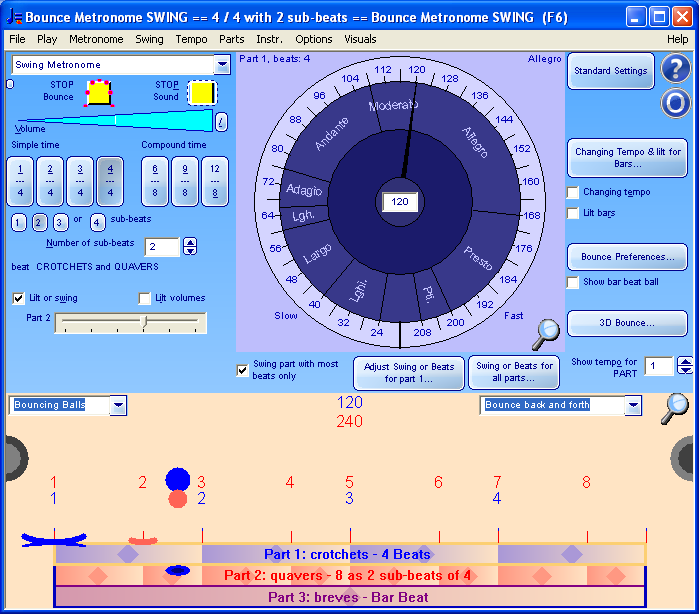
Screen Shot (doesn't play notes) You use the slider to adjust the amount of swing. The fastest notes in the rhythm get swung - here the quavers (eighth notes). You can choose a light swing, medium swing, hard swing, or amounts of swing between those amounts. There is help with the program for all the controls. Every thing you can adjust in this screen shot comes with detailed help which shows up when you hover the mouse over it. You get a short tool tip which explains it briefly, and then in the Help window simultaneously you see a detailed description which (when necessary) goes into detail of all the ways you can use the control, with tips, suggestions etc.. The innovative bouncing ball visuals (following path of ball bouncing under gravity) help to improve sensitivity to irregular rhythms such as swing. As with the Basic Metronome, you can accent or unaccent beats with RIGHT CLICK, skip beats with LEFT CLICK, adjust beat volumes with MIDDLE CLICK or SHIFT + LEFT CLICK. For details see the page about the Basic metronome. Get your free fully featured 30 day Test drive : Videos4/4 with light eighth note swing
The bounce inside ovals option is particularly useful for swing as it helps you to see the shorter and longer beats and their positions in the bar visually. Adjust individual beats, lilt volumes and syncopated rhythmsAfter you set the level of swing with the slider, you may feel you want to adjust individual beats in the rhythm. You can do that, with just click and drag. You can also vary the volumes, and similar to the swing, there's a "lilt volumes". You can either set it to normal accents with the first subdivision the stronger one, or Jazz type accents with the second (normally weaker) subdivision louder. I'll do more videos for the rest of this page soon. Had some old videos and sound clips but they need to be updated. Meanwhile just descriptions will do for the rest of this page. Or download the program and try it out for yourself :) to see what you can do.
Swung triplets as in Scottish and Irish traditional musicFor 6/8 and other rhythms in triple time with the eighth notes (quavers) as the fastest beat, the notes are swung as triplets instead of pairs of notes. This sort of rhythm is used, for instance, in jigs in Scottish or Irish dance music. Note - this is not the same as the "triplet time" interpretation of ordinary Jazz type swing as quarter note + eighth note instead of two eighth notes, sometimes done as a way to help you learn the timing. In Scottish Jigs, you have genuine triplet patterns -all six notes of the 6/8 played in many of the measures. Each of the three notes in each of the triplet patterns is played with a different time. Listen carefully to the timing of the notes in any Scottish jig to hear what I am talking about here. It's a complex rhythm, if you try to analyse it, with the first note longer, second note shorter, third note in between in timing. Then fourth, firth and sixth notes follow a similar pattern, just a tiny smidgen faster. It takes a long time for instrumentalists not used to the genre to learn to play a Scottish jig properly.
Jig with liltIn many styles of music musicians play rhythms with subtle changes of note length and subtle tempo changes from one bar to the next. Scottish or Irish dance music is a particularly good example to work with to bring this out, as it is noted for its swing, and also has a great deal by way of subtle timing variations. The Jigs in Celtic Music are swung perhaps most of all, and are particularly tricky for newbies to play. To find out more about the swing rhythm for jigs in Celtic music see Jigs: trickier than probably you thought. If you listen to Scottish or Irish dance music, you can hear that jigs (slow ones especially) are often played with the second half of the bar very slightly faster than the first. The middle beat of the bar is just a smidgen late, almost imperceptibly - not enough to feel irregular, just to give it a bit of a lift, more than if you played both halves exactly the same to the millisecond. Jig with lilt barsAlso if you listen to a Scottish or Irish Jig, you may hear that individual bars vary in tempo too (around a steady tempo for the jig as a whole). This is a subtle variation I'm talking about here. The first four bars in a jig are often in the pattern normal speed, slightly faster, normal, slightly slower. The pattern depends on the tune, anyway if you switch on lilt bars you get a variation in tempo which may perhaps feel more natural and so be easier to practice with than a fixed tempo. I think the reason these slight variations in tempo feel natural is that when we move then e.g. when walking, or running, strides vary slightly in time, from one stride to the next - unless you are pretending to be a robot :-). So in the same way when we play, it can feel more natural to have (just very slightly) varying timings for the bars around a steady tempo, and it may sound more natural and organic to listeners too. The metronome can't do all the variation of a human player, but it can do enough to make the music feel a bit more organic, also to help to prevent you locking too much into a pattern with every measure the same exactly - which feels unnatural especially in Scottish dance music. You can only play the rhythms, not the tunes. In the future I plan to add abc notation to Bounce Metronome so that it can play traditional tunes along with the rhythm. en.
Metrical pulseIn Bounce Metronome Pro the number of subdivisions that get swung is called the "metrical pulse" (for want of a better word for it). So the jigs have a metrical pulse of 3 beats with each of those different in time when played with swing .The normal swing has a pulse of 2 beats with first longer than second. In other types of music you may want to use a metrical pulse of more than 3 beats. For instance in say 4/4 with four sub-beats you could try a metrical pulse of 4 instead of 2. The beats are played gradually faster like the bounces of a bouncing ball or a drum stick released and allowed to bounce lightly on a drum. This is obviously of particular interest for drum rudiments, and is used for the "Buzz roll". But done more subtly, almost any rhythm can sound better with a small amount of lilt for the measure as a whole, superimposed on the more obvious and stronger swing for the subdivisions.
Swing with 4 beat pulseYou can also try a swing with a 4 beat pulse.
Creative use of irregular metrical pulsesYou can set the pulse to anything you like - it doesn't have to be related to the rhythm of the bar. For instance, try 4/4 with 4 sub-beats with a metrical pulse of 5.
Swung Notes - background informationSwung notes are a feature of many types of music. Notes are played alternately longer and shorter than usual though normally notated all the same length. The amount of swing can be vary e.g. a light swing of 3:2 or a hard swing of 3:1 or a medium swing of 2:1 which corresponds to a triplet crotchet + triplet quaver - but would be notated as a pair of quavers. See the wikipedia entry Swung notes. For the early music use (notes inégal) see notes inégal (Wikipedia), notes inégal (Dolmetsch) with precursors much earlier in the Ars Antiqua rhythmic modes: Rhythmic mode (Wikipedia) Gentle LiltNearly all types of music the beats in a bar are uneven in a subtle way. Musicians play like this even when they don't realise they are doing it - you notice it if you compare it with computer generated music with the notes all exactly the same length. Varying the beat with a gentle lilt makes the music much more natural sounding and it is likely to be easier to play along with. If you find it hard to play your notes exactly in time with the beats of a metronome, but easy to play along with other musicians, it may well be because you are used to playing with a lilt and can't adjust your playing to the strict clock like beat of a metronome. In that case it is better if you can adjust the metronome to play a lilt :-) (unless you need to play a clock-like strict beat for some reason for a particular piece say). Lilt or swing here is done with a natural decay, faster and lighter, like the bounces of a drumstickWhen lilted or swung in pairs then the second beat is normally faster than the first in each pair. When lilted in triplets or more than three notes, there are many choices you could make about how to do it. But one natural and straightforward way to do it is to make each beat faster than the previous one exactly in the way it happens with a bouncing ball or drumstick (exponential decay), followed by a very slightly longer beat to raise the drum stick before the next series of bounces. That's how it is done here. Get your free fully featured 30 day Test drive :
Or download your 30 day Free Test Drive - including your free taster time signature metronome which is yours to keep whether you buy or not
More Videos:Watch Gravity Bounce |



|
|
|
♥ |
| Disclaimer |
| Products - Music - Bounce Metronome |  |
| free of spyware etc |  |